Preps: sauces, dough, fillings
What the kitchen makes itself — written once, used by the gram everywhere.
A sauce, a stock, a dough, sushi rice — none of them are on the menu, but they all leave the store. They live in Store → Tech cards → Preps.
This is the entire point of the section: a kitchen with six sauces and forty dishes otherwise writes the same tomatoes into seven places — and the seven copies stop agreeing within a month.
Writing a prep
- 1New prep — give it a name: «Somsa filling», «White sauce».
- 2Choose the unit: kilo (used by the gram), litre (by the millilitre) or piece.
- 3List the ingredients and the quantities for one batch.
- 4Enter the yield: how much one batch produces.
- 5Save. It now appears in dish cards like any other ingredient.
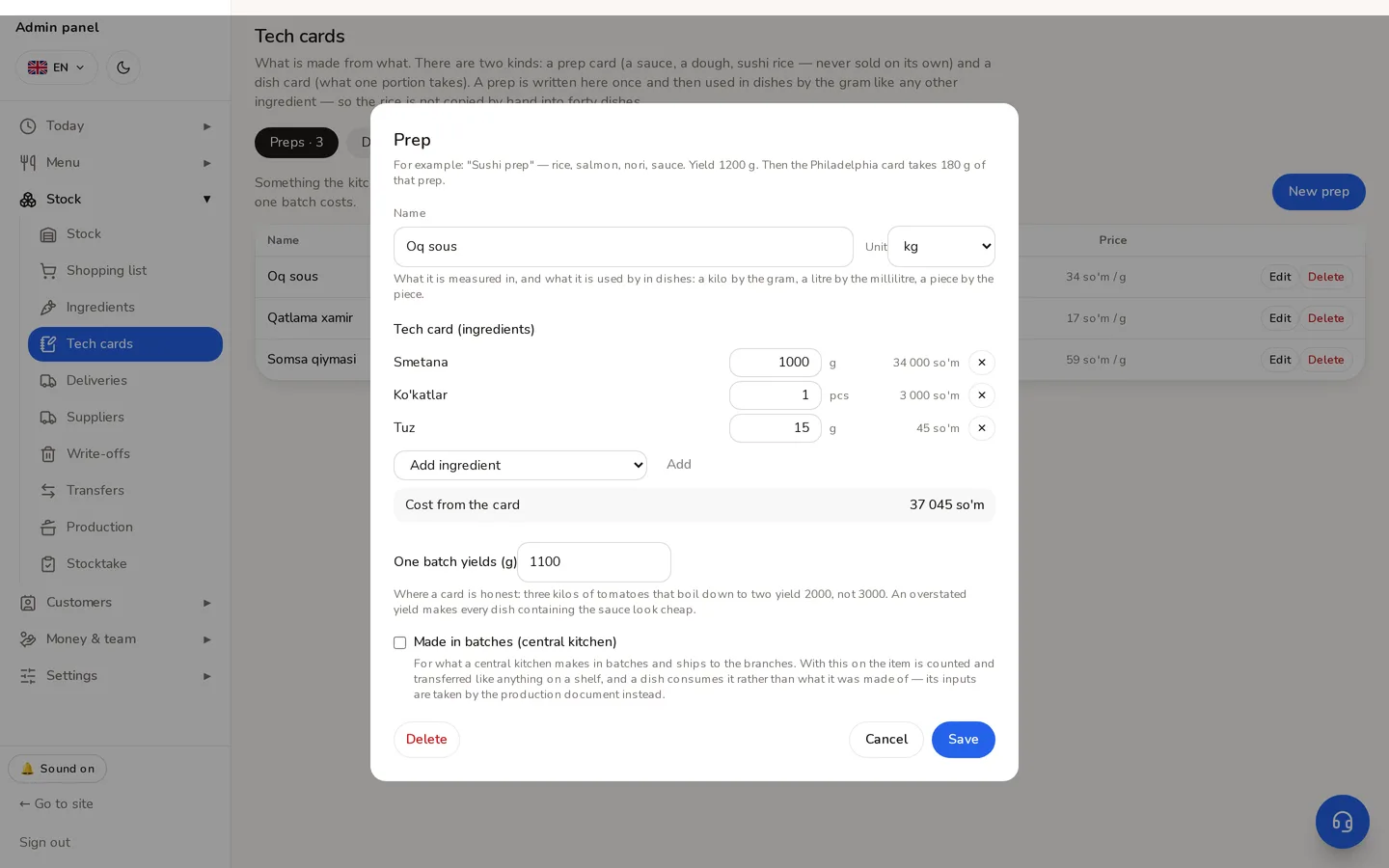
A prep has no price to type: its price is what a batch costs divided by what it yields. That is why the price field is not on screen at all.
Are preps counted?
Usually no: nobody counts «sauce», they count tomatoes, and a dish with sauce reads as a dish with tomatoes. For a chain with a central kitchen there is a «Made in batches» switch — with it on, the prep is counted as a real thing on a shelf and transferred between branches.
Didn't find the answer?
Write on Telegram — a person answers. Tell us which screen you are on and what you expected, and the answer comes in the first reply.
Telegram